
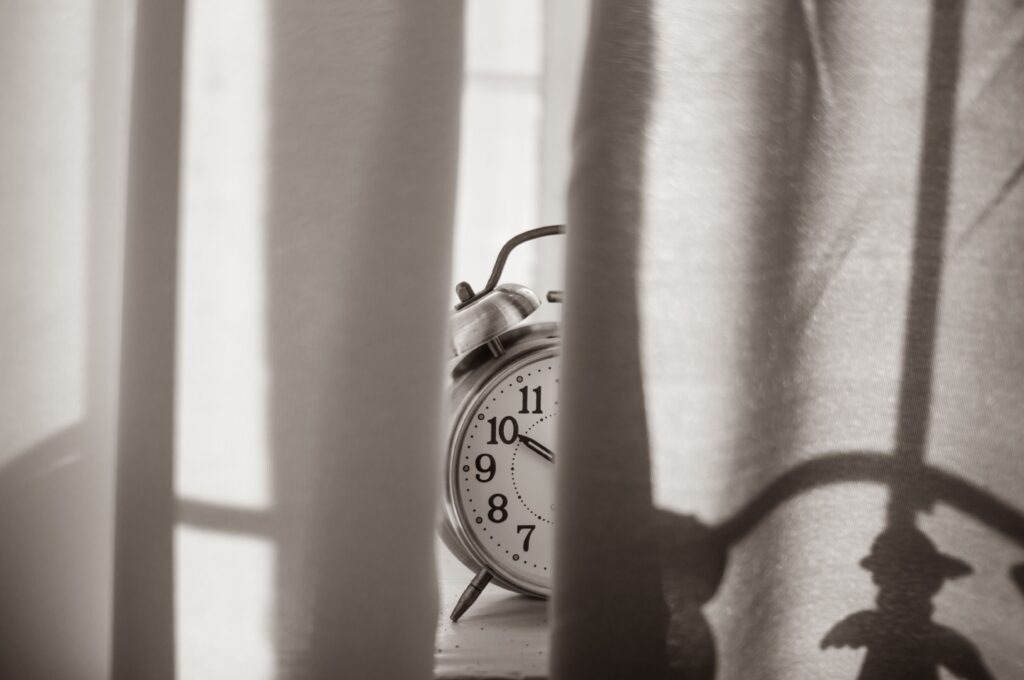
This Sunday, November 1, at 2 a.m., the clocks fall back an hour. Officially we “gain” an hour of sleep. Unofficially, half of us will be up at 5:30 anyway, the dog will want breakfast on the old schedule, and by Tuesday it will be pitch dark at 6 p.m. and we will all be wondering if it is bedtime yet.
I used to treat the time change as a minor annoyance, like resetting the clock on the microwave (which, let’s be honest, I usually skip until spring). Then a study landed in my inbox this week that made me look at those shorter days a little differently. It turns out the light you get during the day may say something important about your brain.
What the New Daylight Study Found
Researchers publishing in the journal General Psychiatry tracked 87,577 adults from the UK Biobank who wore wrist devices that measured how much light they were exposed to, day and night. Over a median follow-up of about eight years, 741 of them developed dementia.
Here is what stood out. People whose average daytime light was above 1,000 lux (roughly the brightness of an overcast day outdoors) had a 16% lower risk of dementia than people who spent their days in dimmer light. Those who logged at least 42 minutes a day in bright light of 5,000 lux or more had a 17% lower risk.
The part that made me sit up: getting less than 42 minutes of bright daylight a day was a stronger predictor of dementia than six well-known risk factors. Nighttime light, on the other hand, showed no meaningful connection. It was the daytime brightness that mattered.
Now, the honest fine print. This is an association, not proof. The researchers did not show that sunshine prevents dementia, and they say more research is needed. People who are already healthier may simply get outside more. Still, the lead researcher called daytime light a possible new marker of dementia risk, and when the “treatment” is a walk around the block, I am not waiting for the sequel.
Why Your Living Room Is Darker Than You Think
Most of us spend the bulk of our day indoors, and indoor light is much dimmer than what is outside, even on a cloudy afternoon. Your eyes adjust so well that you never notice. That cozy reading lamp by your recliner? Nowhere near 1,000 lux.
And this is the time of year when it gets harder. Once the clocks change, the sun sets before many of us finish dinner. If your bright-light time used to come from an evening walk, Sunday quietly takes it away unless you move it to the morning or midday.
The Napping Connection
This study arrived right on the heels of another one worth knowing about. In October, researchers at the Johns Hopkins Bloomberg School of Public Health published findings in The Journal of Gerontology: Medical Sciences after following nearly 1,000 adults 65 and older for about a decade. Those who napped most days or every day had a 48% higher risk of developing dementia. People who dozed off without meaning to had a 39% higher risk.
Before anyone cancels their Sunday afternoon nap in a panic, the researchers were clear: frequent napping may be an early sign of changes in the brain rather than a cause. The takeaway is not “never nap.” It is “notice.” If you or someone you love is suddenly nodding off in the chair every afternoon, that is worth mentioning to the doctor.
Light and sleep are connected, too. Bright light during the day helps set your internal clock, which helps you sleep better at night, which can mean fewer surprise naps the next afternoon. It is one loop, and you can nudge it in the right direction.
Your Fall Back Game Plan
Here is how I am handling the next few months, and what I would suggest to anyone over 60 who wants to come out of winter sharper than they went in:
- Book a daily date with daylight. Aim for 40 minutes or more outside, ideally in the morning or around lunch. Coffee on the patio counts. So does walking to the mailbox the long way.
- Move your favorite chair. If you read, do puzzles, or scroll the news in the same spot every day, put that spot by your brightest window. As a Senior Home Coach™, natural light is one of the first things I look at in a home, and this is a big reason why.
- Brighten the inside, too. Brighter bulbs in hallways, kitchens, and stairways make evenings easier on the eyes and help prevent trips. Plug-in night lights with motion sensors are inexpensive and earn their keep fast.
- Rethink evening errands. According to AAA, a 60-year-old needs three times more light to see the road than a 20-year-old. The National Safety Council reports that while only about a quarter of driving happens after dark, half of traffic deaths happen at night. Run errands earlier, clean your headlights and windshield, and get your annual eye exam on the calendar.
- Pay attention to naps. A planned 20-minute rest is one thing. Falling asleep mid-sentence most afternoons is information. Share it with your doctor.
My podcast conversation with master fitness trainer and world-record masters rower David Frost on Episode 85 of Relax, I Got This! Embracing Life After 60 was all about the simple daily habits that keep us strong, active, and independent. A daily walk in the sunshine just picked up a second job.
Shorter Days, Bigger Choices
I love that this research hands us something free, easy, and frankly pleasant to do. No prescription, no gym membership, no app with a password you will forget. Just you, a pair of comfortable shoes, and the sky.
So when the clocks fall back Sunday, use it as your cue. Set the microwave clock (or don’t), and then go stand in the sun for a while. Your brain may thank you, and your neighbors will wonder why you are suddenly so cheerful in November.

And if this has you thinking about whether your home works for the way you want to live these next years, from the light in the living room to the stairs you are tired of climbing, I am always happy to talk it through. No pressure, just a good conversation.

Robin McCoy
Realtor® | Senior Home Coach™
214.226.3770 | RelaxIGotThis.com | Robin@RelaxIGotThis.com
Sources
- ScienceDaily / Wiley: Less than 42 minutes of bright daylight linked to higher dementia risk (Oct. 29, 2026)
- Zheng et al., General Psychiatry: Wearable-device-measured daytime and nighttime light exposures and dementia risk (2026)
- SciTechDaily: Not getting enough daylight could be linked to a higher risk of dementia (Oct. 19, 2026)
- Johns Hopkins Bloomberg School of Public Health: Frequent, unintended napping tied to higher dementia risk (Oct. 13, 2026)
- FOX 5 New York: Dementia risk may be linked to seemingly harmless daily habit (Oct. 22, 2026)
- Sleep Foundation: Daylight saving time (end date Nov. 1, 2026)
- AAA Northeast: Changing clocks means more emphasis on safety
- Public Health Dayton & Montgomery County: The most dangerous time to drive (citing National Safety Council)